
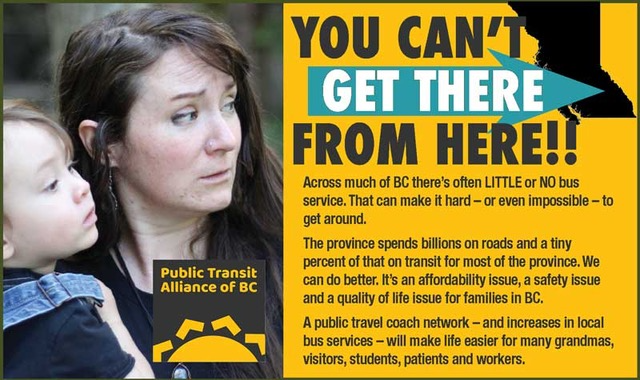
Urgent need for public, affordable, intercity coaches, better rural transit!
British Columbia governments spend billions of dollars every year on highways and hundreds of millions of dollars on urban transit services, but our transportation system fails non-drivers who live in rural communities or who want to visit another city. Inadequate transit services leave many people behind. That is wasteful, costly and unfair.
Two elections, one message
Municipal elections take place October 17; we elect mayors, city councillors and regional directors. The provincial election takes place October 24; we elect Members of the Legislative Assembly (MLAs). All three levels of government affect public transit: local and regional governments plan and share in funding of local transit services; the provincial and governments fund transit services through BC Transit.
Everyone can raise the lack of frequent transit at forums, get letters in newspapers, call in to talk shows, share memes and information on social media sites. Talk about the terrible, non-existent state of this essential public service that is almost completely missing in much of BC.
Outside greater Vancouver and Victoria barebones routes and infrequent buses cause problems for anyone who doesn’t drive. Getting to medical services, sometimes at a hospital hundreds of kilometres away can be almost impossible or very expensive.
Transit is ALWAYS a local issue. Local politicians are often aware of the real barriers to easily getting around. But NOT all politicians are equally aware. These elections coming up can include discussions on the transportation AND transit crisis across BC.
British Columbia needs better transit
Our current public transit system fails to serve many people, including rural residents and businesses, families with low incomes, visitors, and motorists when their vehicles are not available. Frequent and affordable transit service benefits everybody: it provides basic mobility for non-drivers, helps families save money and reduce traffic problems and pollution. Improving public transit ensures that everybody, including people with disabilities and low incomes, and rural communities, receive their fair share of transportation infrastructure spending.
- Many BC communities lack reliable and affordable transit. This is unfair to non-drivers and rural communities.
- Community service agencies, and even the public health system, have to cobble together volunteer drivers and local programs to help people get to appointments, groceries and where they absolutely must travel. It’s expensive for agencies and for BC families.

- Many travellers do not drive and will use public coaches IF it is convenient and affordable.
- Improving transit benefits users and communities including affordability, rural economic development, plus less traffic congestion, risk and pollution.
- Every year the province spends hundreds of dollars per capita on highways and dozens of dollars annually for local transit services, but only a few cents on interregional bus services that connect communities. Transit users deserve our fair share!
Examples…
…from Vancouver Island:
BC Transit operates four daily buses between Victoria and Duncan with $10 one-way fares, and only seven buses between Duncan and Nanaimo with $5 fares.
Because service is infrequent and expensive transit only serves a tiny portion of travel on that corridor.
In contrast, there are 43 daily trips between Sooke and Victoria with $3 one-way fares; transit carries an impressive 22% of peak-period trips on that corridor, demonstrating that many travellers will choose buses if service is convenient and affordable.
…from Southern BC:
In Nelson there is NO direct bus to the Trail Regional Hospital. Other travel is costly: $200 ticket for an infrequent private bus to Vancouver. High profile intercity and local transit issues burden nearly every BC community outside Victoria and the lower mainland.

Questions for candidates
Provincial Candidates
- At a time of growing need – and even desperation – improving transit is a triple win: save families money, help people get to health care, schooling and work they need, and reduce traffic and fossil fuel emissions.
- Will you support moving significantly more of the provincial transportation budget into boosting public transit?
- Will you support creation of a public, province-wide, intercity coach network?
Municipal Candidates
- Will you be a strong advocate for increasing access to public transit, bus routes and bus frequency in your community?
- What are you going to do about the need for a frequent bus to the regional hospital?
- Community social service agencies all over the province are responding to the crisis with volunteer driver networks – piecemeal, desperate fixes. Isn’t usable public transit an essential public service? Shouldn’t it be adequately funded?
- Will you work to improve bus stops and add bus lanes where buses get stuck in traffic?
All Candidates
- What will you do to improve local and interregional transit connections? Will you be a strong advocate for increasing access to public transit, bus routes and bus frequency in your community?
- Transit users face many obstacles including a lack of rural and intercity connections, limited evening and weekend services, crowded buses, unsafe stops, and poor user information. What will you do to fix these problems?
- Inadequate transit services have serious costs: missed healthcare appointments, jobs, shopping and family events, reduced economic opportunities, expensive taxi trips, and dangerous hitchhiking. What will you do to further transit improvements and address these problems?
Tools for raising transit issues
Brainstorm questions for candidates
Reach out to your local networks with some of the best local transit questions to raise with candidates. Identify local needed transit routes, health facility travel gaps, frequency barriers to use.
Have a ride the bus event for local candidates
Plan and invite all the candidates to a public event to ride a bus. Choose a route if possible that highlights the gaps or insufficiencies. Take pictures with the candidates who show and share on social media.
Public event or rally
Mobilize your activists well in advance, promote on social media and networks. Have signs and short statements ready. Invite local candidates to show support. Tell your supporters when candidates say they are coming.
Letter writing campaign to local publications
More letters improves the chances some of them will get published. Most editors recognize that if several individual letters come in, at least one of them deserves to be published. Individualized letters are best.
Social Media Onslaught
If you can create a meme or just a simple statement, post it and post it and encourage friends to share and comment.
Candidate forums
Ask forum organizers to include transportation issues in their fixed questions or themes.